
Replacing a 3080 With a V100
At NURDspace we have been using a GeForce RTX 3080 for our AI setup. The card served KlikoAI and the IRC channel. However, I recently found out that eBay is getting flooded with cheap Nvidia Tesla V100s. The 16GB VRAM version is about €250, while the 32GB sits unfortunately around the €600 mark. The comparison is somewhat interesting as the 3080 (10GB) sells around €300–400.
About the V100
So what is the V100? It’s a datacentre Tesla card, a pretty old one with first-generation Tensor cores released back in 2017. It comes in two variations: the standard PCIe, and the SXM2 connector made for Nvidia server motherboards. A lot of these SXM2 GPUs are now getting dumped on eBay after the Summit supercomputer got decommissioned, flooding the second hand market. People made SXM2 to PCIe adapter boards and started selling them cheaply.
Nowadays you can buy a PCIe adapter board that comes with the GPU itself as well as cooling included, since the bare SXM2 module was never designed for consumer systems. The end result is a proper PCIe card, just… enormous and heavy.
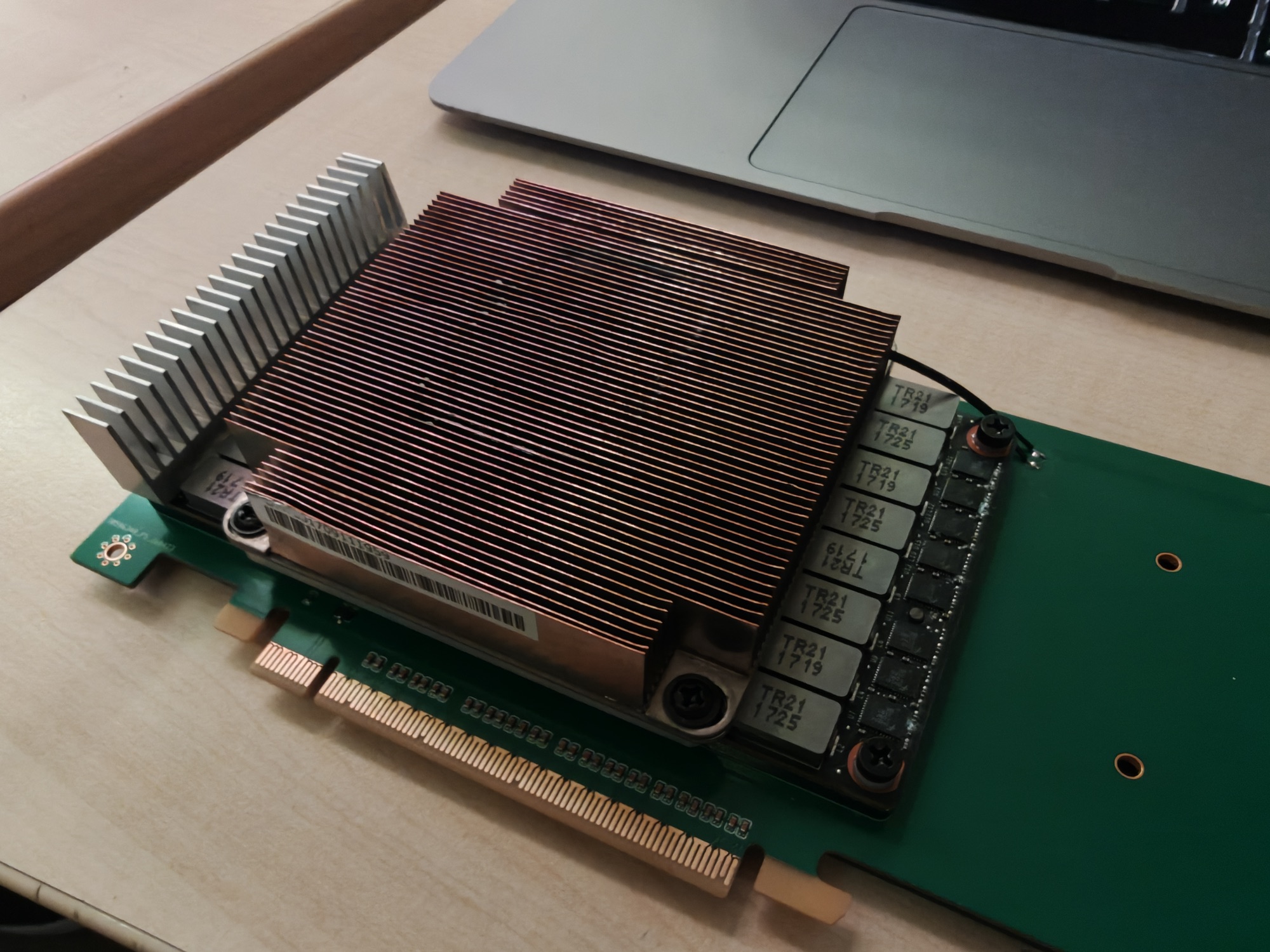
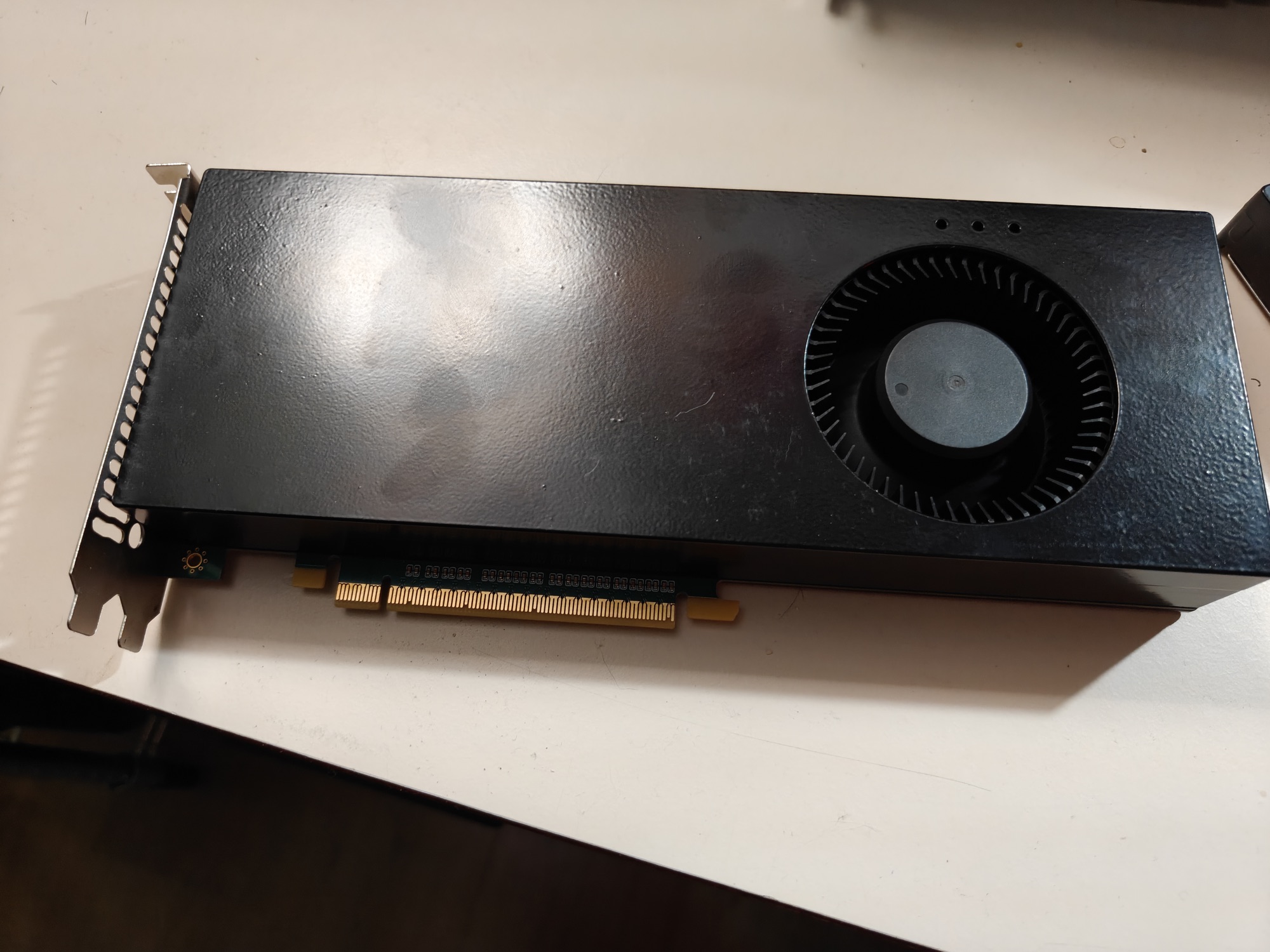
So why bother? For inference workloads, VRAM is king. The V100 gives you 16GB for around €250, which is hard to beat at that price point, especially when compared to a used 3080 with only 10GB.
Caveats
Being an older Volta card, driver support is limited. Branch 580 is the last to support Volta, with full updates ending July 2026, after which only security patches will follow. For a dedicated inference box this is unlikely to matter much in practice; the card will keep working, just without any new driver features or bug fixes.
The CUDA toolkit is moving on as well: CUDA 13 dropped Volta (compute capability 7.0) as a compile target, so anything you build yourself, like llama.cpp, needs a CUDA 12.x toolkit. Volta also has no native BF16 support. llama.cpp can still run BF16 models on it, just not efficiently, so you’re better off with FP16 or a quantised format. And as a datacentre card it has no display outputs, so you’ll need another GPU or an iGPU if the machine needs a screen.
+-----------------------------------------------------------------------------------------+
| NVIDIA-SMI 580.142                Driver Version: 580.142        CUDA Version: 13.0     |
+-----------------------------------------+------------------------+----------------------+
| GPU  Name                 Persistence-M | Bus-Id          Disp.A | Volatile Uncorr. ECC |
| Fan  Temp   Perf          Pwr:Usage/Cap |           Memory-Usage | GPU-Util  Compute M. |
|                                         |                        |               MIG M. |
|=========================================+========================+======================|
|   0  Tesla V100-SXM2-16GB           Off |   00000000:06:10.0 Off |                    0 |
| N/A   40C    P0             38W /  300W |   15077MiB /  16384MiB |      0%      Default |
|                                         |                        |                  N/A |
+-----------------------------------------+------------------------+----------------------+

+-----------------------------------------------------------------------------------------+
| Processes:                                                                              |
|  GPU   GI   CI              PID   Type   Process name                        GPU Memory |
|        ID   ID                                                               Usage      |
|=========================================================================================|
|    0   N/A  N/A           30706      C   ...ama-cpp-9493/bin/llama-server      15072MiB |
+-----------------------------------------------------------------------------------------+
The “CUDA Version: 13.0” in there is the highest CUDA version the driver supports, not the toolkit you build with.
The keen-eyed among you might have noticed that the card reports no fan speed. This is because these cards were originally cooled by the airflow of the servers they sat in. The PCIe adapter cards sold on eBay include a temperature sensor in the cooler that controls the fan directly. At idle, this keeps the card at around 40°C and around 80°C under load. The fan is pretty noisy however!
Specs, 3080 vs the V100
| Spec | RTX 3080 | V100 (SXM2 16GB) |
|---|---|---|
| GPU Clock (Boost) | 1710 MHz | 1530 MHz |
| VRAM | 10GB GDDR6X | 16GB HBM2 |
| Memory Bandwidth | 760 GB/s | 900 GB/s |
| FP32 | 29.8 TFLOPS | 15.7 TFLOPS |
| FP16 (Tensor) | 119 TFLOPS* | 125 TFLOPS |
| TDP | 320W | 300W |
| Architecture | Ampere (2020) | Volta (2017) |
* With FP16 accumulate. GeForce cards run FP16 with FP32 accumulate at half rate, so 59.5 TFLOPS.
On paper the V100’s HBM2 should give it an edge, since for LLM inference memory bandwidth roughly translates to tokens per second, and 900 GB/s even comes close to a 3090’s 936 GB/s. In practice the newer architecture makes up the difference, as you’ll see below.
So how does it compare?
I did run the same benchmarks on our 3080 before swapping it out, and the V100 came out at roughly twice the speed. Which sounded great, until I compared the numbers with what other people get. Our 3080 was generating at about half the speed it should, and its prompt processing got slower with longer prompts, while clocks and temperatures looked completely normal. Something was off with it, and the card has since left the building, so I can’t rerun it.
So instead, here’s a fair comparison from the llama.cpp CUDA scoreboard, where people run the same llama-bench test (Llama 2 7B Q4_0, flash attention on) on their cards:
| Prefill (512 tokens) | Generation (128 tokens) | |
|---|---|---|
| RTX 3080 10GB | 5570 tok/s | 140 tok/s |
| Tesla V100 32GB | 2974 tok/s | 135 tok/s |
The scoreboard only has the 32GB V100, not the 16GB one I’m using. Both have the same GPU and 900 GB/s of memory bandwidth, so speed should be the same as long as the model fits.
For generating text, which is most of what we do, a healthy 3080 and a V100 are about even. The 3080 is almost twice as fast at prefill though, which matters if you feed it long prompts. So the V100 doesn’t win on speed. What it wins on is that it does the same job with 6GB more VRAM, for less money.
The V100 in numbers
All benchmarks ran on an ASUS ROG STRIX B550-F GAMING with an AMD Ryzen 9 5900X (12C/24T, up to 4950 MHz) and 128 GB of DDR4, running NixOS with driver 580.142. Everything was measured with llama-bench (llama.cpp build 9493) with flash attention on and all layers offloaded to the GPU (except for the MoE test below), while logging power draw with nvidia-smi.
Generation speed, generating 128 tokens from an empty context:
Prefill, processing a 2048-token prompt:
Under load the card pulls around 190–250W during generation, and sits at about 38W idle. Not exactly frugal for something that’s on 24/7.
VRAM headroom
This is where the V100 earns its place. The extra 6 GB isn’t just a number, some models simply don’t fit on a 10GB card. The 3080 couldn’t load Gemma4 12B Q8_0 (12.6 GB) or Qwen3.6 27B (14.5 GB) at all. The V100 handles both without issue:
The 35B figure deserves a note: the V100 can’t fit a 22 GB model in full either, but Qwen3.6 35B is a Mixture of Experts model where only a fraction of parameters are active per token. By keeping 12 of the expert blocks in CPU RAM and the rest on GPU, llama.cpp can run it on 16 GB at 56 tok/s. The 3080 ran out of memory even with that trick. With all experts on the CPU, the V100 still manages 25 tok/s.
Verdict
For the kind of LLM inference we do at the space, the V100 is a good deal at around €250. It generates about as fast as a 3080, costs less, and the extra 6GB of VRAM lets it run models the 3080 simply can’t load.
But for a homelab? I wouldn’t recommend it. The card is loud and heavy, draws more power, driver support is on its way out, prefill is a lot slower, and FP32 performance is about half that of the 3080.
So: if you want a cheap card with lots of VRAM for a dedicated box running llama.cpp, get a V100. If you want a quiet, flexible, do-everything GPU, keep the 3080.